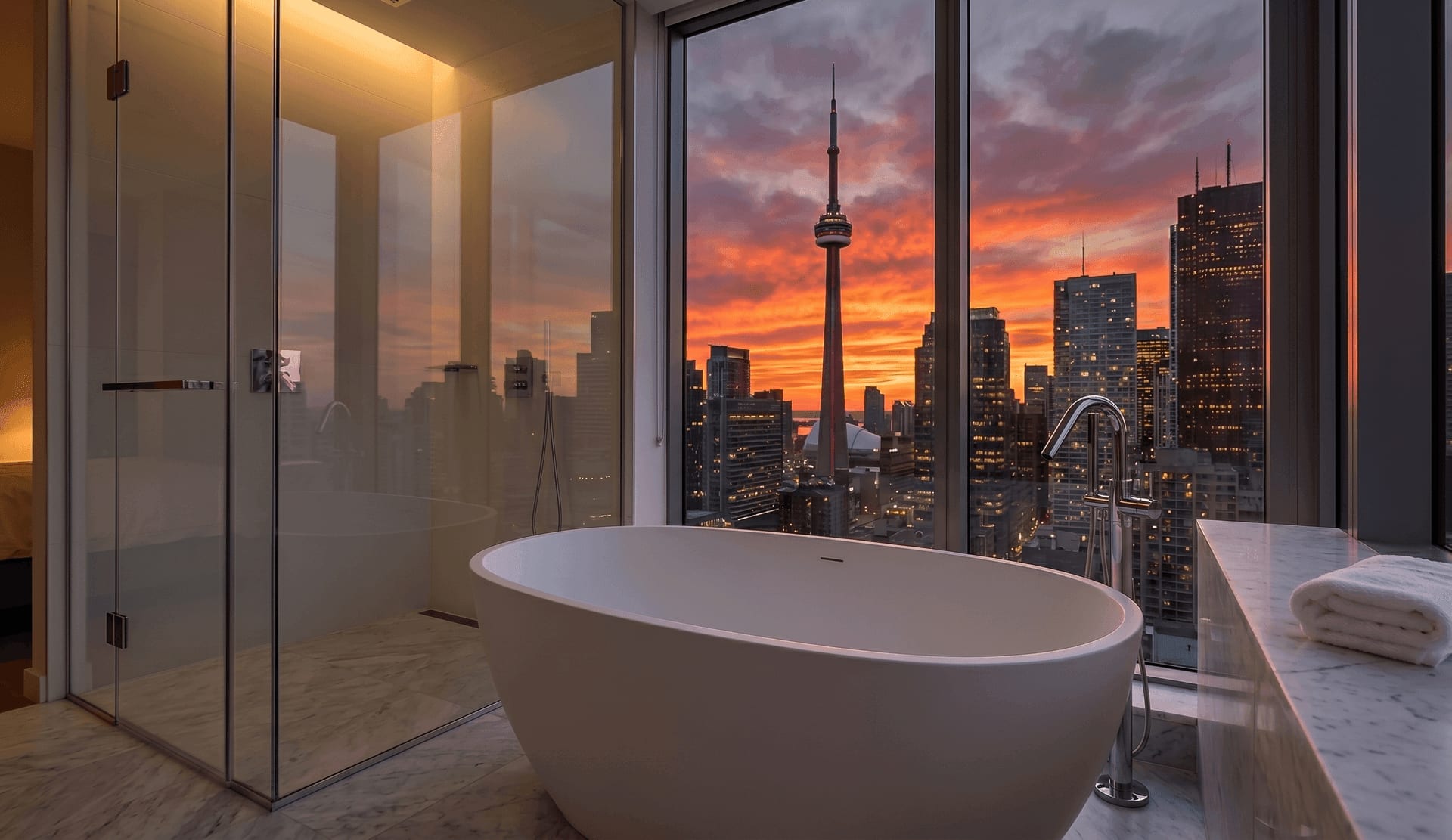
Every frameless shower enclosure, every glass railing, every floor-to-ceiling interior partition you see in a modern GTA home has one thing in common: the glass was almost certainly tempered. Yet most homeowners have no real idea what that means, why it's legally required in those applications, or how to tell the difference from the untreated alternative. This guide changes that — because understanding what's in your walls, showers, and railings isn't just interesting. It matters when you're buying, renovating, or asking a contractor the right questions.
What Tempered Glass Actually Is
Tempered glass — also called toughened glass — is standard float glass that has been transformed through a controlled heat-treatment process. The raw material starts identical to the glass in your windows: silica sand, soda ash, limestone, and dolomite melted together and drawn into flat sheets. What sets tempered glass apart isn't its chemistry. It's the internal stress profile engineered into it during manufacturing.
Through rapid heating and cooling, the outer surfaces of the glass sheet are forced into a state of compression while the inner core is held in tension. These competing stresses are what give tempered glass its remarkable properties. The compressed surface layer resists scratches, bending forces, and thermal shock far better than untreated glass. And when the glass does break — when the stress threshold is exceeded — those internal tensions cause it to shatter in a very specific, much safer pattern.
It's worth being clear about what tempered glass is not. It's not a special coating. It's not a laminate. It's not thicker glass. The transformation happens at the molecular level through controlled stress, and there's no visible difference between a tempered panel and an annealed one unless you know exactly what to look for.
The Tempering Process, Step by Step
Understanding how tempered glass is made helps explain why the limitations and benefits exist. Every sheet goes through the same fundamental sequence:
-
Cutting and edge workThe glass is cut to its final dimensions before tempering. This is a critical point we'll return to — once glass is tempered, it cannot be cut or drilled. All holes, notches, cutouts, and edge profiles must be completed in this raw state.
-
WashingThe cut panels are thoroughly cleaned to remove any debris, oils, or particles that could cause imperfections during heating. Even a small speck of contamination can create a stress point that causes breakage in the furnace.
-
Tempering furnaceThe glass travels into a horizontal roller furnace on ceramic rollers, where it's heated uniformly to approximately 620°C (1,150°F) — well above the glass transition temperature of around 564°C. This takes several minutes depending on thickness.
-
Rapid quenchingThe heated glass exits the furnace and is immediately blasted from both sides with high-pressure cold air jets. The surfaces cool and harden rapidly while the interior remains hot and viscous. This creates the compression-tension differential that defines tempered glass.
-
Quality inspectionEach panel is checked for distortion (tempering causes slight waviness known as "roller wave"), optical quality, and stress uniformity. Polarized light testing can reveal the stress patterns within the glass.
-
Stamp / certification markCompliant panels receive a permanent etched or ceramic-fired mark — the "bug" — indicating the safety standard, manufacturer, and class. In Canada this references CAN/CGSB-12.1 or ANSI Z97.1.
"Tempered glass doesn't just break differently — it was engineered specifically to fail safely. That's the entire design intent."
Built By Glass — Installation TeamWhy It's So Much Stronger
The 4–5× strength figure gets quoted often, but it's worth understanding what it actually means. Glass fails in tension — when a surface is pulled apart by a bending force, it cracks. Because the surfaces of tempered glass are held in compression, an applied bending force must first overcome that preloaded compression before the surface even begins to experience tension. The glass essentially has a "head start" of resistance built in.
This is the same engineering principle behind prestressed concrete — you pre-compress the material so that real-world loads never actually create tensile stress. In tempered glass, the surface compression layer typically runs to about 20–30% of the total glass thickness on each side, with the tensile core in between.
The compressive stress also provides significant resistance to thermal shock. When you run a hot shower and then introduce cold water, the temperature differential across the glass is significant. Annealed glass can crack from this alone — tempered glass handles it without issue. This is one reason building codes specifically require it in shower enclosures, not just for breakage safety.
How It Breaks — And Why That's the Point
When tempered glass is struck hard enough to break — an impact at a corner or edge where the compression layer is thinnest, or the application of a very concentrated point load — the stored internal energy releases all at once. The entire panel "dices" into thousands of small, roughly cubic fragments rather than the long, knife-like shards that annealed glass produces.
These fragments are not harmless — they can still cut — but they're far less likely to cause serious lacerations or penetrating injuries. The glass doesn't collapse in one catastrophic shear; it falls mostly in place, in a pile of small pieces. This is the safety mechanism the building code is relying on when it mandates tempered glass in locations where breakage near a person is plausible.
One important implication: you cannot selectively break just part of a tempered glass panel. The internal stresses are interconnected. A single impact at sufficient force releases the whole system simultaneously. This is why a shower door that falls and hits a floor at its corner often shatters completely — even though most of the glass wasn't struck.
Where Ontario's Building Code Requires It
The Ontario Building Code (OBC) — primarily Part 9 for residential and Part 3 for large buildings — mandates safety glazing in specific locations. If you're renovating in Ontario, these are non-negotiable, and a building inspector will check them. Here are the most common residential applications:
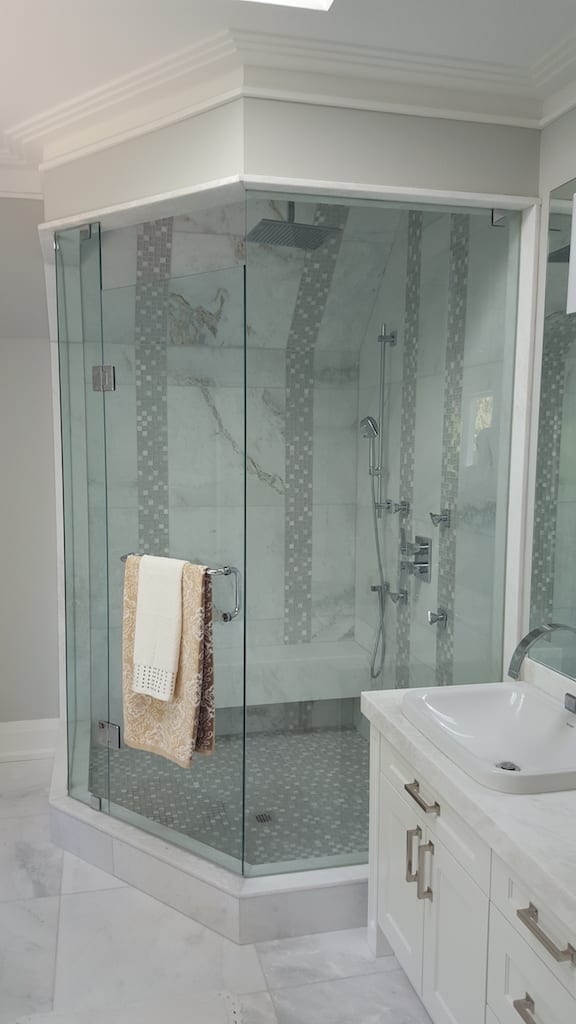
- Shower and bathtub enclosures: All glass in contact with the wet area. No exceptions — annealed glass in a shower enclosure fails code.
- Glass railings: All panels in a guard or railing assembly, interior or exterior.
- Door sidelights and transoms: Any glazing within 300mm (12") of the edge of a door.
- Low-level glazing: Glass where the bottom edge is within 500mm of the floor (so a person could walk into it).
- Skylights and overhead glazing: Any glass installed at an angle — typically requires laminated tempered.
- Stair enclosures and landings: Any glass adjacent to a staircase.
- Steam showers: Must handle thermal shock in addition to impact — tempered is the standard.
The practical implication for homeowners: if a contractor quotes you a shower enclosure or glass railing and doesn't mention tempered glass as the default, ask directly. If they're supplying annealed glass, that's a code violation, a liability issue, and a serious safety risk.
Planning a shower or railing install?
Built By Glass uses certified, OBC-compliant tempered glass on every project. Family-owned, Founder-Led Standard, 5-year warranty.
Tempered vs. Laminated vs. Annealed Glass
These three types appear constantly in glass specifications, and they're often confused. Here's how they actually compare:
| Property | Annealed (Float) | Tempered | Laminated |
|---|---|---|---|
| Relative strength | Baseline (1×) | 4–5× stronger | Similar to annealed per ply |
| Breakage pattern | Long, sharp shards | Small, blunt pebbles | Stays in place (held by interlayer) |
| Post-break safety | ✗ Dangerous | ✓ Much safer | ✓✓ Safest — holds together |
| Can be cut after processing | ✓ Yes | ✗ Never | ✗ No (except with special tools) |
| OBC shower enclosures | ✗ Not permitted | ✓ Compliant | ✓ Compliant |
| OBC railings | ✗ Not permitted | ✓ Compliant | ✓ Compliant (often preferred) |
| Overhead / skylights | ✗ Never | ✗ Risky (can fall as pebbles) | ✓ Required by code |
| Cost relative to tempered | 30–50% cheaper | Reference price | 40–80% more expensive |
| Sound damping | Standard | Standard | Significantly better |
Laminated glass — two or more glass plies bonded with a PVB (polyvinyl butyral) or ionoplast interlayer — is the choice when you need glass to stay in place after breakage. Overhead skylights are the clearest example: if the glass breaks, you don't want it falling as pebbles on the person below, even blunt ones. Laminated glass holds together at the interlayer. For railings on elevated decks, many engineers and municipalities now specify laminated tempered for the same reason.
Tempered Glass Cost Per Square Foot in Canada
Tempered glass is priced two very different ways, and mixing them up is the most common budgeting mistake we see. Supply-only panel pricing — a bare tempered sheet from a fabricator — varies widely with thickness, size, edgework, and order volume, so no single per-square-foot number is honest for every case. Installed pricing is what actually matters for a renovation, because it includes the measure, custom fabrication, hardware, and the install visit.
Our installed rates across Toronto and the GTA are published and consistent:
- 10mm tempered shower glass — $40 per square foot installed ($850 project minimum)
- 12mm tempered shower glass — $50 per square foot installed
- Smoked / tinted tempered glass — $55 per square foot installed
- Fluted or textured tempered glass — $60 per square foot installed
- Tempered glass railings — priced per linear foot instead: $220/LF for 10mm, $260/LF for 12mm ($1,400 project minimum)
- Mirror glass — $25 per square foot installed, no project minimum
For worked project examples, see the frameless shower cost guide and the glass railing cost guide, or get an instant range for your dimensions from Build & Price.
How to Identify Tempered Glass
Every certified piece of tempered glass in Canada should carry a permanent identification mark — called the "bug" in the glazing trade — etched, sandblasted, or ceramic-fired into one corner of the glass, usually a lower corner. This mark is small (roughly 2–4 cm), often partially obscured by frames or seals, and easy to miss if you don't know to look for it.
The bug typically contains: the manufacturer's name or logo, the applicable safety standard (ANSI Z97.1 in North America, or CAN/CGSB-12.1 for Canadian-certified glass), and a classification (e.g., "Class A" for tempered safety glass). If you're buying a home or a contractor is claiming to use tempered glass, ask to see the bug on each panel. A reputable installer will never object to this.
A secondary method of identification is polarized light. If you look through a tempered glass panel with polarized sunglasses at an angle, you'll often see a faint grid pattern or colour variation — this is the stress pattern from the roller furnace visible through polarization. It's not perfect for identification but it's a useful field check.
The One Thing You Can Never Do
This deserves emphasis: tempered glass cannot be cut, drilled, or significantly modified after tempering. This is one of the most practically important facts about the material. The moment a tempering furnace processes a piece of glass, its internal stress state is locked in permanently. Any attempt to cut it — whether with a glass cutter, a wet saw, or a drill — causes the entire panel to explode into the characteristic pebble fragments immediately.
This is exactly why all sizing, hole drilling (for hardware like hinges, handles, and clamps), edge notches, and custom shapes must be specified and completed before the glass enters the tempering furnace. In practice, this means that when you work with a quality glass company, the measure-to-order process is precise and non-negotiable. There's no "we'll trim it a bit on-site." Each panel is a one-shot custom fabrication.
The implication for homeowners: if a contractor offers to modify a piece of tempered glass on the job site, they're either uninformed or planning to use non-compliant annealed glass. Either way, it's a serious red flag. Similarly, if your glass panel doesn't fit because measurements were wrong, it cannot be salvaged — it needs to be reordered.
When getting a quote for frameless glass installation, ask specifically: "Will the panels be custom-tempered to my exact dimensions?" The answer should always be yes. Panels cut from pre-tempered sheets (a cost-cutting practice) won't fit as precisely and may not carry full safety certification for your specific application.
Frequently Asked Questions
Yes — though it's rare. The most common cause is nickel sulfide (NiS) inclusions: tiny contaminants that occasionally form during glass manufacturing. NiS particles undergo a phase change over time and can expand enough to trigger spontaneous breakage. Estimates put the rate at roughly 1 in 10,000 panels, though it varies by manufacturer and process quality. Reputable glass manufacturers control for this through quality screening at the tempering stage. At Built By Glass, any breakage that originates from our drilling, cutting or edgework is covered under our 5-year written workmanship warranty; other breakage is replaced at material cost.
No. Tempered glass is significantly stronger than regular glass, but it's not ballistic-rated or forced-entry resistant. For security applications, you'd want laminated glass (which holds together after breakage, making forced entry slower and louder) or polycarbonate-laminated glass systems. Tempered glass can be broken with a glass-breaking tool — notably a spring-loaded "resqme" tool or similar — applied to a corner. This is actually important to know: if you're trapped in a vehicle with tempered side windows, striking the corner is how you escape.
Suction cup accessories (like corner caddies or razor holders) can generally be used carefully on tempered glass, but they need to be applied and removed gently. The concern isn't the suction itself but the potential for torquing the glass panel when removing a stuck suction cup. Never drill into installed tempered glass — that will cause immediate, complete breakage. Any hardware mounting (towel bars, handles) must be through pre-drilled holes made before tempering, or via clamp-style hardware that doesn't penetrate the glass.
Safety glass is the broader category. Both tempered glass and laminated glass qualify as safety glass under most building codes, because both break in a significantly less dangerous way than annealed glass. The specific type required depends on the application — showers typically accept either, skylights require laminated, and railings increasingly specify laminated tempered for maximum protection. "Safety glass" without further qualification isn't a specific material — always ask which type is being proposed.
Not significantly. Tinted glass (grey, bronze, blue, green), low-iron ultra-clear glass (like Starphire), and coated glass can all be tempered. The furnace parameters may be adjusted slightly for different glass compositions, but the process and the resulting safety properties are the same. Low-iron glass is becoming increasingly popular in high-end shower installations because it eliminates the green tint that standard clear glass shows — especially visible at the edge of thick panels.
Every panel we install is tempered to these standards — see our frameless shower doors, glass railings, and commercial glazing pages.
Ready to put the right glass in your home?
Built By Glass supplies and installs certified tempered glass for frameless showers, glass railings, and custom mirrors across the GTA. Every panel is custom-sized, OBC-compliant, and backed by our 5-year installation warranty.
Prefer to talk it through? Call 647-778-0430.