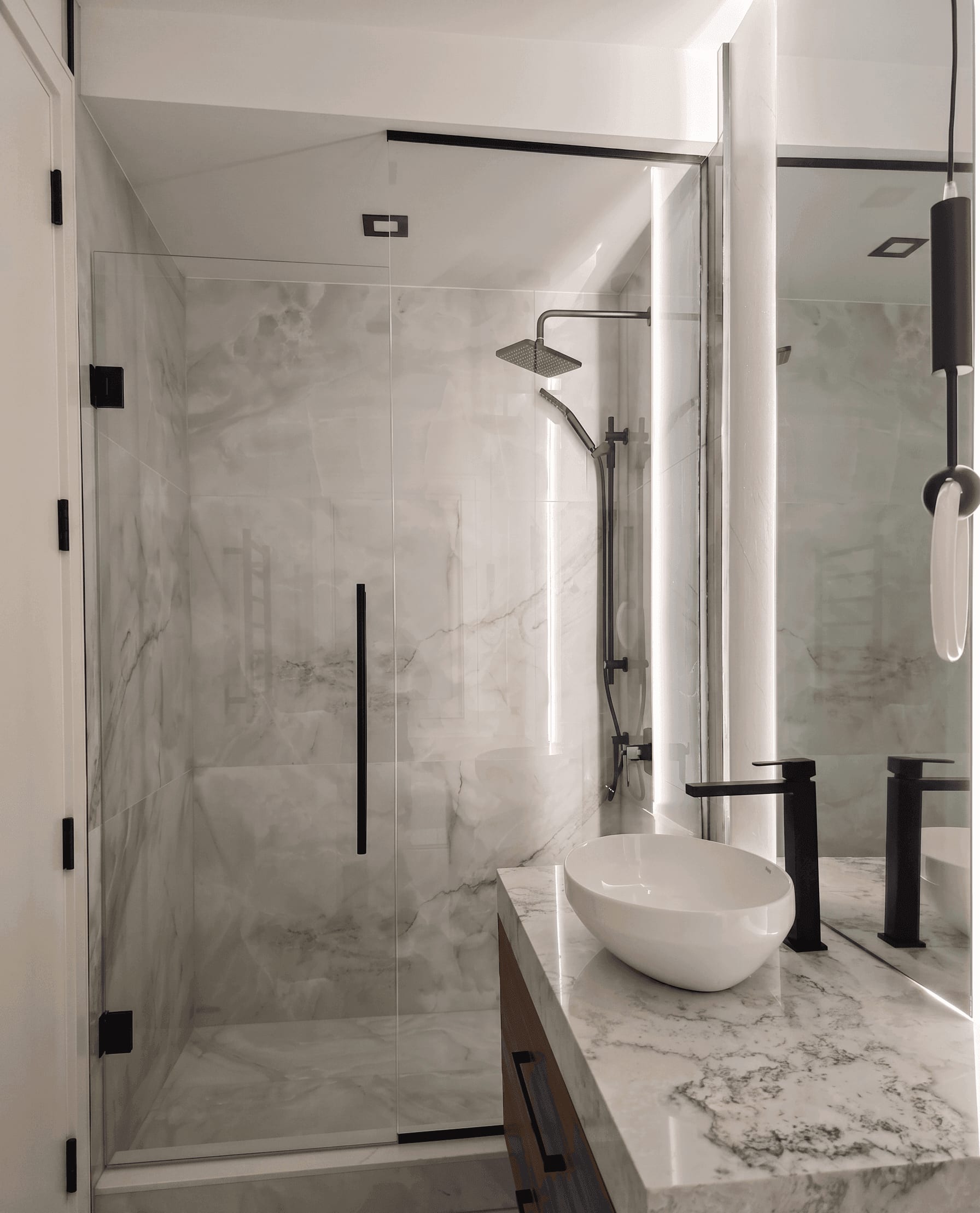
Glass thickness comes up in almost every frameless shower consultation, and it almost always causes confusion. The numbers — 8mm, 10mm, 12mm — don't mean much without context. Is thicker always better? What's the real-world difference between 10mm and 12mm? And is the extra cost worth it? This guide gives you a definitive answer based on engineering reality and practical install experience — not just what sounds premium.
Why Thickness Actually Matters
Glass thickness in a frameless shower isn't purely cosmetic, though it has a significant cosmetic component. Structurally, thicker glass deflects less under load — whether that's a person leaning against a panel, a door swinging on its hinges, or wind load on an exterior application. In a frameless system where the glass is the structural element (there's no frame to transfer forces to the wall), the glass itself must be thick enough to handle the stresses without flexing to the point of failure or seal fatigue.
The aesthetic dimension is equally real: thicker glass simply looks and feels more substantial. Running a hand along the edge of a 12mm panel versus a 10mm panel is immediately noticeable — the 12mm has a heft that communicates quality in a way that's hard to fake. This is why the glass thickness question matters both structurally and for the premium experience you're trying to create.
Finally, thickness affects hardware selection, structural support requirements, and — to a degree — the installation process. You can't simply substitute 12mm panels into an enclosure designed around 10mm without revisiting every hardware component.
The Three Options at a Glance
- Fixed panels & partitions
- Not for hinged doors
- Lowest cost option
- Limited hardware choices
- Standard hinged doors
- Typical enclosures to 2100mm height
- Full hardware range
- Best value for most homes
- Large openings & tall doors
- Heavy pivot doors
- Maximum "luxury feel"
- Commercial-grade durability
8mm Glass: The Partition Standard
Eight-millimetre tempered glass is the appropriate choice for fixed panels — the stationary sides and back wall of a shower enclosure — where the glass is supported on multiple edges and doesn't need to bear the dynamic loads of a moving door. It's also used extensively in interior glass partitions, office dividers, and lightweight frameless applications where the glass runs in a channel at both top and bottom.
What 8mm is not appropriate for: hinged shower doors, pivot doors, or any panel that will receive regular dynamic loading. An 8mm hinged door flexes perceptibly during opening and closing, which accelerates seal wear and creates an imprecise, cheap-feeling user experience. If a contractor quotes you 8mm for a frameless hinged door, that's a specification compromise you should push back on.
The practical reality: most premium residential frameless installations use 10mm throughout for a consistent feel, reserving 8mm for specific partition applications where cost is a priority and the glass is fully supported.
10mm Glass: The Everyday Workhorse
Ten-millimetre tempered glass is the industry standard for residential frameless shower installations, and for good reason. It's structurally appropriate for all standard enclosure configurations — single hinged doors, side panels, inline (walk-in) panels — up to typical residential heights of 2100–2200mm. It's heavy enough to feel solid, light enough to not over-stress hinges, and available in the full range of hardware systems from every quality manufacturer.
A standard 10mm shower door (say, 900mm wide × 2100mm tall) weighs approximately 47 kg. That's not light — and it means the hinge hardware matters. Quality heavy-duty hinges with solid brass or 316 stainless construction handle this load without issue. Cheap hinges sag over time, causing the door to drop at the latch side. This is almost always a hardware failure, not a glass failure, but the glass gets blamed because it's the most visible element.
For the vast majority of GTA homeowners renovating a master bath, 10mm is the correct and recommended specification. The structural performance is more than adequate, the hardware selection is excellent, and the cost is significantly lower than 12mm. The premium feel of 10mm, installed correctly with quality hardware, is exceptional.
"For most residential frameless showers, 10mm is not a compromise — it's the right specification. Choosing 12mm for a standard enclosure is like buying a sports car for a school run. Impressive, but not the optimal tool."
Built By Glass — Technical Specification Notes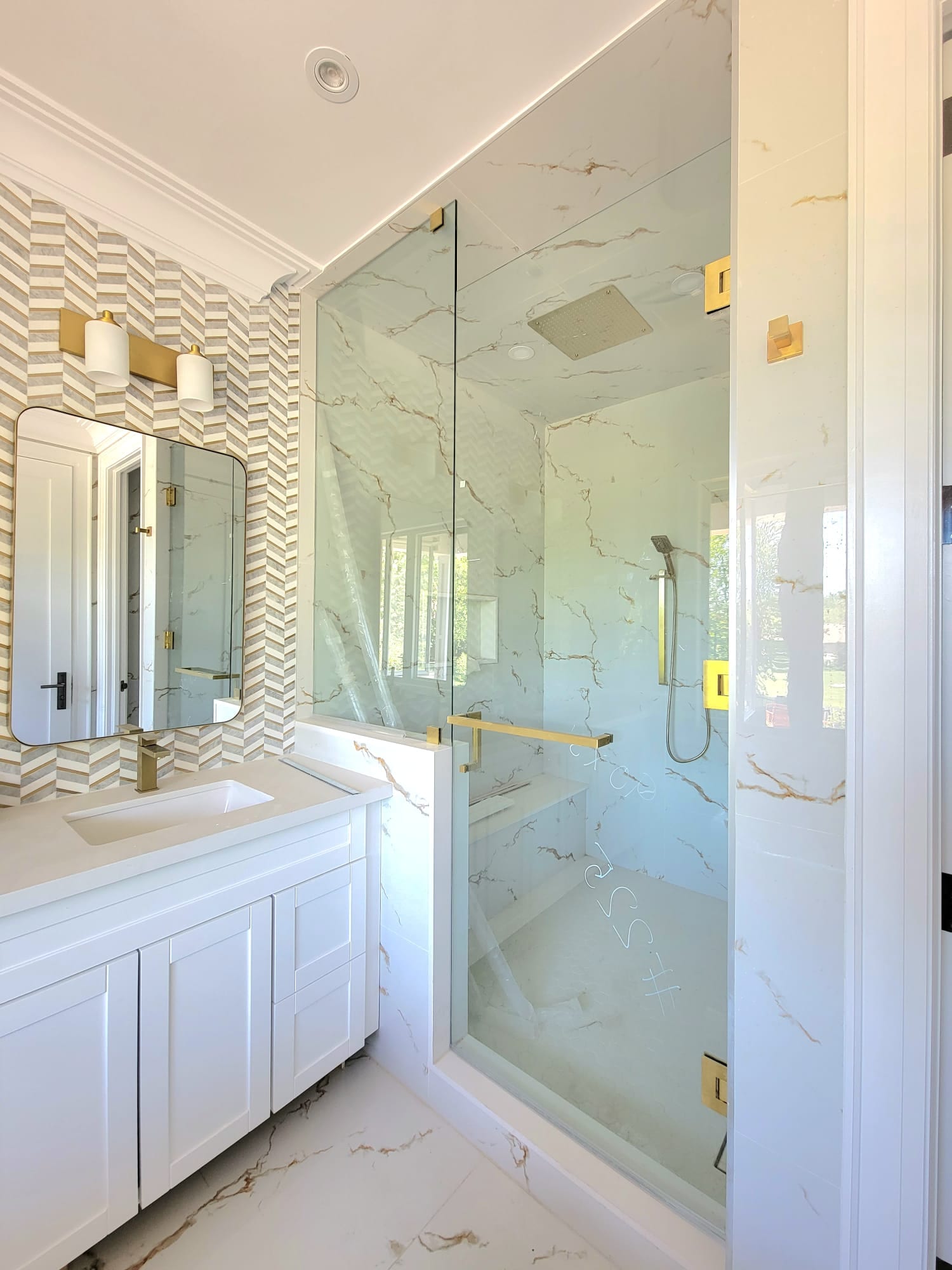
12mm Glass: The Premium Upgrade — When It's Actually Worth It
Twelve-millimetre tempered glass is the specification for installations where: the opening is exceptionally large (doors wider than 1000mm or taller than 2200mm), the design calls for a heavy pivot door that will be leaned on, or the client is simply committed to the absolute maximum weight and presence that glass can deliver.
At 30 kg/m², a 12mm door panel is substantially heavier than 10mm. A 900×2100mm door in 12mm weighs approximately 57 kg — 10 kg more than the equivalent 10mm. This requires heavier-rated hinges (typically with a larger stainless pin and wider bearing surface) and careful consideration of the structural support at the wall. In some cases, 12mm glass doors require reinforced blocking in the shower wall framing to carry the hinge loads without deflection over time.
The subjective experience of 12mm is real and significant. The door swings with a visceral, vault-like heft. The edge — visible in a frameless installation at eye level — is noticeably thicker and reads as seriously premium. If you're building a high-end master bath and the shower is the centrepiece, 12mm is the specification that matches that ambition. In a typical $600,000–$800,000 renovation budget, it's worth the premium.
Not sure which thickness is right for your project?
Built By Glass provides free technical consultations and will recommend the exact specification for your opening size, design goals, and budget.
Hardware: The Hidden Factor in Thickness Decisions
Glass thickness and hardware are inseparable in a frameless installation. This is the factor that gets overlooked when homeowners compare thickness options online, and it's critical.
Every piece of frameless shower hardware — hinges, clamps, channels, handles — is designed for a specific glass thickness range. A hinge rated for 10mm glass has a 10mm slot machined into it. You cannot install 12mm glass into a 10mm hinge (it won't fit), and you cannot install 10mm glass into a 12mm hinge (it will rattle and wobble). This seems obvious, but it means that choosing between 10mm and 12mm locks in your entire hardware system.
The implication: if you're considering 12mm glass, budget not just for the glass premium but for the heavier hardware that must accompany it. High-quality 12mm-rated hinges, clamps, and bottom channels are typically 15–25% more expensive than their 10mm equivalents, because they use more material and bear greater loads.
Fixed shower panels often sit in a floor channel rather than being fully frameless (to achieve a water seal without framing). The channel width must exactly match the glass thickness. A 10mm panel in a 12mm channel will wobble; a 12mm panel in a 10mm channel won't fit. Confirm thickness consistency across all panels before ordering.
Application Guide: Which Thickness for Which Use
| Application | 8mm | 10mm | 12mm |
|---|---|---|---|
| Hinged shower door (standard, up to 900mm wide) | ✗ Not ideal | ✓ Recommended | ✓ Premium option |
| Hinged shower door (over 900mm wide) | ✗ Not suitable | △ Use with extra care | ✓ Recommended |
| Heavy pivot door (any width) | ✗ Never | △ Acceptable to 900mm | ✓ Best choice |
| Fixed panel (standard height) | ✓ Acceptable | ✓ Standard | ✓ Premium |
| Walk-in / inline panel (no door) | △ Clamp-supported only | ✓ Standard | ✓ Premium |
| Glass railing panel | ✗ Fails load test | ✓ OBC compliant | ✓ OBC compliant |
| Interior office partition | ✓ Standard | ✓ Premium feel | △ Heavier than needed |
| Frameless shower up to 2100mm height | ✗ Too light | ✓ Standard specification | ✓ Upgrade option |
| Frameless shower 2100mm–2700mm height | ✗ Never | △ Engineer assessment needed | ✓ Recommended |
The Cost Difference
Glass cost is typically quoted per square foot for the glass itself, before hardware and installation. The premium for 12mm over 10mm works out to roughly $10 more per square foot of glass ($40/sqft for 10mm clear versus $50/sqft for 12mm), before hardware and labour.
When you add in the heavier hardware required for 12mm — hinges, clamps, handles rated to the higher load — the total premium for choosing 12mm over 10mm on a standard residential enclosure typically runs $300–$600 more in glass cost plus additional hardware. On the overall installation, upgrading from 10mm to 12mm is roughly a 25% premium on the glass rate ($40/sqft vs $50/sqft), with hardware costs scaling accordingly.
Whether that premium is justified depends entirely on your context. For a $750K–$1M Oakville master bath where the shower is the centrepiece, it's a reasonable investment. For a guest bath in a $550K Pickering semi, the same budget would be better spent on hardware finish or glass type.
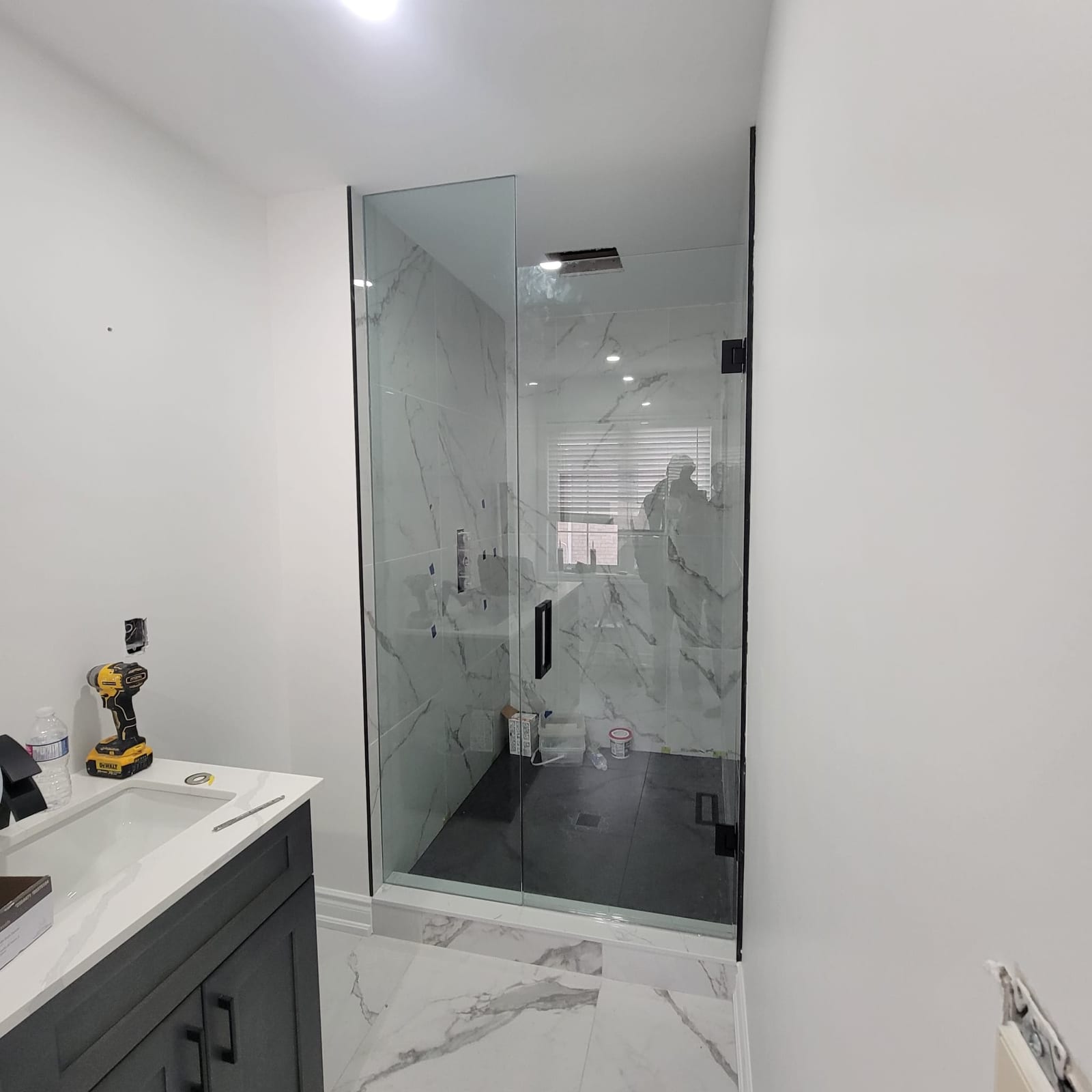
How to Choose: A Simple Framework
Here's a straightforward decision framework:
- Standard residential master bath, door up to 900mm wide, height under 2200mm: 10mm. It's the right specification — not a compromise.
- Large master bath feature shower, doors over 900mm wide, or ceiling-height to 2400mm+: 12mm. The extra thickness handles the longer lever arm of a wider or taller panel.
- Statement installation — floor-to-ceiling glass wall or heavy pivot door designed to impress: 12mm with premium hardware. This is where the thickness premium fully pays its way.
- Guest bath or secondary bathroom: 10mm — we don't install 8mm in a frameless configuration. Save the budget for the rooms buyers linger in.
- Tight budget: 10mm glass with excellent hardware is always better than 12mm glass with cheap hardware. Hardware quality drives the daily user experience more than thickness does.
Frequently Asked Questions
10mm fully tempered glass handles most residential shower configurations up to approximately 83 inches (2100mm) in panel height and 35 inches (900mm) in door width. Beyond those dimensions — taller doors, wider single-panel walks, or unusual hinge spans — the door's weight and lever arm exceeds what 10mm safely supports over time, and we specify 12mm. For standard residential masters and ensuites, 10mm is the correct and code-compliant spec.
The visible difference at the glass edge is real but subtle: 12mm shows a noticeably thicker bevel and looks more architectural or substantial. Up close, especially in good lighting, the edge profile difference is obvious. From across a bathroom, most homeowners cannot tell. The bigger visual factor is glass clarity — switching from standard clear to low-iron Starphire (which removes the green tint at the edge) is a far more noticeable upgrade than going from 10mm to 12mm in standard clear.
12mm is mandatory in three scenarios: any single panel exceeding approximately 83 inches (2100mm) in height, steam shower enclosures (where thermal cycling and sealed-ceiling construction add structural demands), and pivot-door installations where the door panel exceeds approximately 35 inches (900mm) in width without intermediate hardware support. Outside those scenarios 12mm is an optional upgrade. For standard residential frameless shower work, 10mm meets every applicable code requirement.
For full service specifications, pricing options, and to start your project, see our frameless glass shower installation page.
Get the right specification for your shower
Built By Glass will assess your opening, design goals, and budget and recommend the exact thickness and hardware combination. No upselling — just the right answer. Serving Pickering, Toronto, Vaughan, Mississauga, and across the GTA.
Prefer to talk it through? Call 647-778-0430.