Glass gets all the attention in frameless shower and railing projects. But the hinges, handles, clips, and standoffs — the hardware — are what you actually touch, see up close, and live with every single day. Get the finish wrong and the whole installation looks off. Get it right and it elevates everything around it.
This guide is the one you should read before you make any hardware decision. We cover every mainstream finish available in Canada right now: what it actually looks like, how it wears, what homes and design styles it belongs in, how to match it across fixtures, and — critically — what grade of metal sits underneath the coating. Because finish and grade are two completely different things, and mixing them up is an expensive mistake.
Hardware is the Jewelry of Your Glass Installation
Interior designers have a saying: hardware is the jewelry of a room. It's a small element that signals taste, quality, and whether the rest of the design is intentional. In glass installations specifically, hardware plays an outsized visual role because there's no tile, no millwork, and no paint to distract. It's glass — and then metal. Those are your only two materials.
When a homeowner walks into a bathroom with frameless glass and matte black hardware, the hardware reads instantly. When someone steps onto a deck with glass railings and champagne bronze standoffs, the metal catches the light before the view does. The finish you choose doesn't just coordinate — it defines the register of the entire space.
"Hardware is the only part of a glass installation you touch every day. Spend 10 minutes choosing your glass. Spend 30 minutes on the hardware."
There's also a practical dimension that homeowners often overlook: coatings wear. Some finishes are durable physical vapour deposition (PVD) coatings; others are electroplated layers that can tarnish, pit, or flake. Some are solid metal with a brushed or polished surface that will look the same in twenty years as it does today. Knowing the difference between a "matte black finish" and actual matte black hardware is not pedantic — it's the difference between replacing hinges in three years or keeping them for life.
Matte Black: The Decade's Dominant Finish
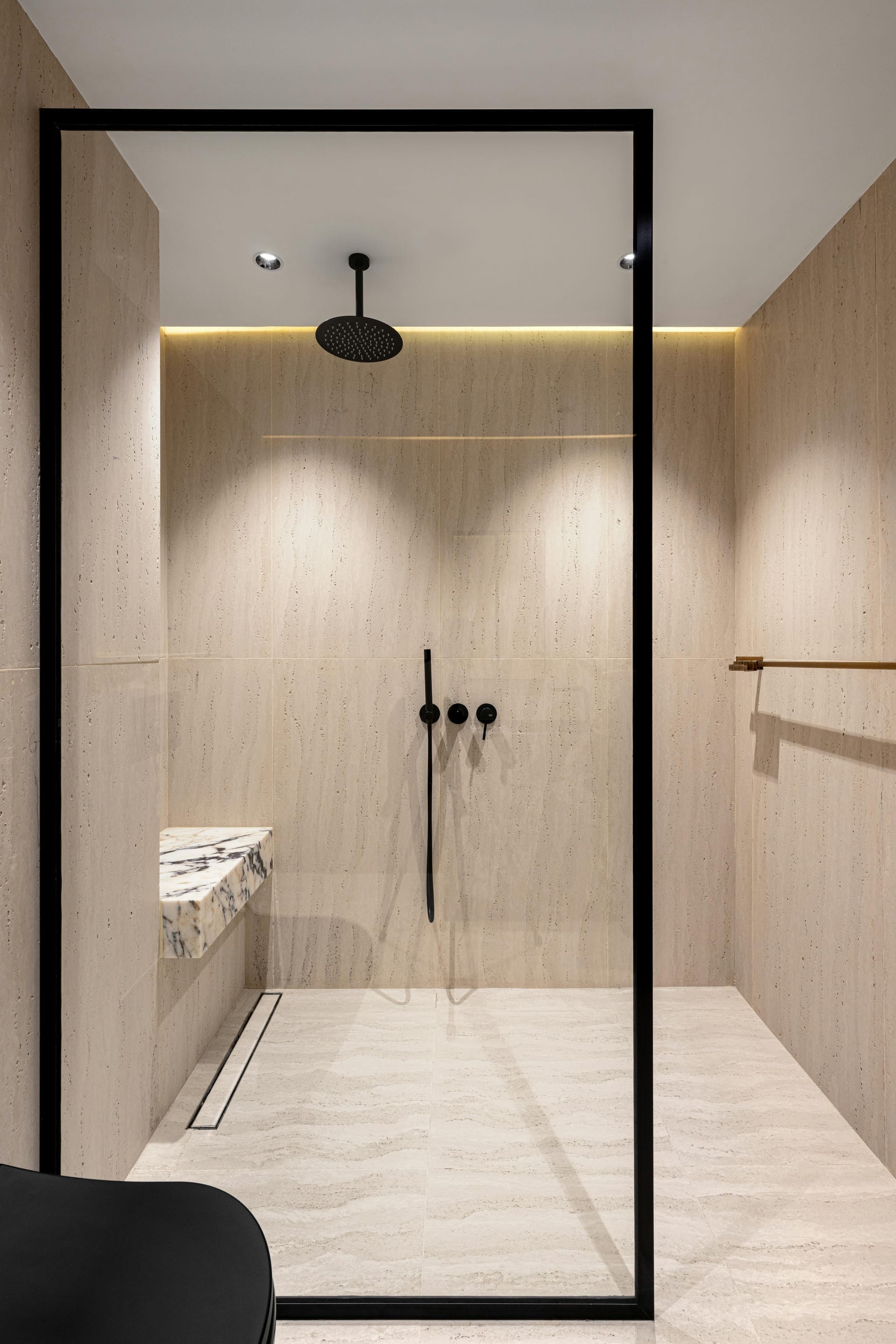
Matte black has been the dominant hardware finish in GTA new construction and high-end renovations for the better part of five years. It photographs beautifully (which matters for resale listings), it contrasts dramatically against white or light grey tile, and it pairs seamlessly with both warm wood tones and cool concrete aesthetics.
It works especially well in frameless shower applications because the hardware itself becomes a design statement rather than a background element. A cluster of matte black hinges and a pull handle on clear glass is architecture.
What to watch for with matte black
Not all matte black hardware is equal. The coating type is everything. Physical vapour deposition (PVD) matte black is applied at the molecular level and is essentially permanent — it won't chip, peel, or change colour. Electroplated matte black is a layer applied over a base metal; it's more affordable but more vulnerable to scratching and can show brass or nickel underneath if abraded.
Ask your supplier specifically: "Is this PVD or electroplated?" Quality glass hardware manufacturers use PVD as standard. If the answer is vague, that's your answer.
Matte black also shows water spots and soap residue more visibly than brushed finishes. This isn't a deal-breaker — a quick wipe keeps it looking perfect — but it's worth knowing if you have young kids or a high-traffic bathroom.
Matte black hardware is one of the few finishes that works in both warm and cool palettes. It pairs equally well with warm white tile + oak vanity cabinets and cool white tile + concrete floors. It loses its edge only in traditional, ornate, or maximalist interiors where it reads too industrial.
Champagne Bronze: The Fastest-Growing Finish in North America
Champagne bronze went from a niche specification to a mainstream first choice in less than three years. In GTA renovation projects, it's now requested nearly as often as matte black in transitional and warm-contemporary bathrooms.
The appeal is straightforward: it delivers the warmth and richness of gold without the maximalism of polished brass. It's a more restrained, grown-up version of the brass revival — one that works with both light and dark palettes.
The champagne bronze coordination challenge
The downside of champagne bronze is that it varies significantly between manufacturers. What Delta calls "champagne bronze" and what Riobel or THG call the same name can look quite different in person — ranging from a pale warm gold to a deeper amber-bronze. When specifying champagne bronze across multiple suppliers (faucets from one brand, shower hardware from another), always request physical samples and compare them in the actual light conditions of your bathroom before committing.
Champagne bronze pairs best with warm whites, cream marble, travertine, warm wood tones, and soft organic textures. It clashes with cool greys, blue-toned tiles, and stark white unless that contrast is very intentional.
Brushed Nickel: The Safe, Proven, Versatile Classic
Brushed nickel is the hardware equivalent of a white button-down shirt: it works everywhere, it never offends, and it holds its value. Unlike trendy finishes that peak and date themselves, brushed nickel has been a consistent top seller for twenty years and shows no signs of feeling dated — because it never felt particularly era-specific to begin with.
For glass installations specifically, brushed nickel is often the smartest choice for homeowners who plan to stay in the house long-term and want hardware that won't need updating when design trends shift. It hides water spots and fingerprints better than both polished chrome and matte black — the satin texture diffuses light and breaks up marks.
Matte Black vs Brushed Nickel: Head-to-Head
If your shortlist is down to these two, here is how they compare on the factors that actually matter once the glass is on the wall.
| Factor | Matte Black | Brushed Nickel |
|---|---|---|
| Visual role | Hardware becomes a design statement against clear glass | Works everywhere without competing for attention |
| Best-fit styles | Modern, industrial, transitional | Contemporary, transitional, traditional |
| Water spots & fingerprints | Shows them clearly; wipe-dry habit needed | Hides them very well; satin texture diffuses marks |
| Durability | Excellent when PVD; electroplated versions can scratch through | Very good |
| Palette flexibility | Works in both warm and cool schemes | Cool-toned |
| Resale appeal | High (currently) | Consistent; never era-specific |
| Choose it if… | You want contrast, you photograph the bathroom, and you'll wipe the hardware down | You plan to stay long-term and want hardware that hides marks and won't date itself |
Both are available in matching hinges, clamps, U-channels and handles from the CRL, Richelieu, FMF and Obsidian lines we install. Configure either one in the Build & Price estimator, then see the physical samples in your own light at the free measure.
Not Sure Which Finish Suits Your Space?
We bring physical finish samples to every in-home consultation. See exactly how each option looks in your actual light before you decide — no guessing.
Book a Free ConsultationPolished Chrome: The Baseline That Never Left
Polished chrome is still one of the most-specified finishes in GTA glass installations, largely in commercial builds, condos, and entry-level frameless shower packages. It's bright, highly legible, easy to clean, and coordinates with virtually any colour palette.
The challenge with polished chrome in a high-end residential context is that it reads as baseline. Buyers and appraisers in the GTA luxury market associate polished chrome with builder-grade finishes — even when the chrome hardware itself is high-quality. If ROI on your renovation matters, chrome is the finish most likely to be noted as "standard" rather than "premium" by a buyer's agent.
That said, polished chrome is genuinely excellent in minimalist and contemporary bathrooms where its mirror quality creates interesting reflections and light play. When used intentionally — not as a default — it can read as deliberate and sophisticated.
Satin & Unlacquered Brass: The Warm Statement
Satin brass occupies a niche but devoted segment of the GTA luxury renovation market. It's warmer than champagne bronze and richer than brushed gold — and in the right interior, it looks genuinely opulent. Think zellige tile, fluted wood panelling, marble floors, arched windows.
Unlacquered brass is a different proposition: it's raw brass with no protective coating, designed to develop a natural patina over months and years. It polarizes opinions. Some homeowners find the living, changing surface beautiful and soulful. Others find it unpredictable and difficult to maintain. If you're considering unlacquered brass, see a sample piece that's been installed for 12+ months to understand what you're committing to.
304 vs 316 Grade Steel: The Decision Beneath the Finish
The finish is what you see. The grade of stainless steel underneath is what determines whether your hardware lasts five years or fifty. This is the most underexplained aspect of glass hardware purchasing, and it leads to expensive surprises — especially in exterior applications.
- 18% chromium, 8% nickel alloy
- Excellent corrosion resistance indoors
- Suitable for interior showers, mirrors, interior railings
- Can develop rust spots in coastal or high-chlorine environments
- Lower upfront cost — 15–25% less than 316
- Most commonly specified in GTA residential installs
- 18% chromium, 10–14% nickel, 2–3% molybdenum
- Molybdenum provides dramatically higher chloride resistance
- Required for deck railings, pool enclosures, and coastal locations
- Significantly more expensive — worth every dollar outdoors
- 3–4× longer service life in outdoor GTA conditions
- The only grade we specify for exterior railing hardware
For interior applications (frameless showers, bathroom mirrors, interior glass partitions), 304-grade hardware will serve you perfectly for decades. For anything exterior — deck railings, balcony glass, pool enclosures, rooftop installations — 316 grade is not optional. The 15–25% cost premium is repaid many times over in avoided replacement costs. GTA road salt, pool chemicals, and freeze-thaw cycles are brutal to 304 in exposed locations.
How to verify the grade
Ask your supplier for the material specification sheet, not just the product description. Legitimate hardware suppliers for glass installations will have these documents readily available. "Stainless steel" without a grade specification tells you nothing. If a supplier can't confirm 316 for an exterior application, find one who can.
Visually, 304 and 316 are indistinguishable. There is no reliable way to tell them apart by looking. The paperwork is the only proof.
The Matching Rules: How to Coordinate Finishes Across Your Home
One of the most common questions from GTA homeowners mid-renovation: "Does everything need to match?" The answer has evolved. The old rule was strict matching — all chrome or all brushed nickel throughout. The current design consensus is more nuanced, and more interesting.
"The biggest finish mistake we see in GTA renovations isn't choosing the wrong finish — it's choosing the right finish in the wrong light. Bring samples home before you commit."
Maintenance by Finish: What Actually Keeps Hardware Looking New
| Finish | Daily Care | Avoid | Restoration | Expected Life |
|---|---|---|---|---|
| Matte Black (PVD) | Wipe dry after use; damp cloth weekly | Abrasive cleaners, bleach, wire wool | Matte black restorer spray (rarely needed) | 15–25+ years (PVD) |
| Matte Black (plated) | Wipe dry immediately; avoid water pooling | All abrasives, strong acids | Difficult to restore once chipped | 5–10 years |
| Champagne Bronze | Damp cloth; dry thoroughly | Acidic cleaners, citrus products | Manufacturer's bronze polish, very gently | 10–20 years (PVD) |
| Brushed Nickel | Damp cloth weekly; buff with microfibre | Bleach-based cleaners, steel wool | Nickel polish; re-buff with grain direction | 15–25+ years |
| Polished Chrome | Wipe dry after every use; buff frequently | Abrasives, harsh chemicals | Chrome polish; re-buff with soft cloth | 10–20 years |
| Satin Brass | Damp cloth; dry immediately | Anything acidic; vinegar | Brass polish; gentle circular motion | 10–20 years (lacquered) |
| Unlacquered Brass | Optional — patina is intentional | Avoid if you want consistent appearance | Brass cleaner to reset; or leave to patina | Indefinite (patina only) |
The one cleaning product to use on everything
For all PVD-coated hardware, the safest daily cleaner is the simplest: warm water and a few drops of dish soap on a microfibre cloth. Rinse with clean water and dry immediately. This removes water spots, soap scum, and mineral deposits without any risk to the coating. Avoid any cleaner marketed as "heavy duty," "descaler," or "bathroom cleaner" — these typically contain acids or abrasives that can degrade coatings over time.
For hard water mineral deposits that don't respond to soap and water, a diluted solution of white vinegar (1:10 with water) applied briefly with a cloth will dissolve calcium without damaging PVD or brushed nickel. Never use undiluted vinegar on any metal hardware, and do not use vinegar at all on brass or champagne bronze finishes.
Frequently Asked Questions
Matte black leads contemporary installs, with champagne bronze the fastest-growing warm finish. Polished chrome and brushed nickel remain the volume standards because they match the widest range of existing fixtures. Built By Glass offers 13 standard finishes across CRL, Richelieu, FMF, and Obsidian hardware lines.
Aim for the same finish family rather than a perfect match — 'brushed nickel' varies slightly between manufacturers. Bring a faucet handle or a photo to your measure appointment and we'll match the closest hardware line. An intentional two-finish pairing, like black glass hardware with brass accents, also works when it repeats consistently through the room.
Water spots show most on dark polished surfaces; matte and brushed textures hide them well. Matte black hides fingerprints better than polished chrome, but it will show mineral scale in hard-water homes if it's never wiped down. A quick towel pass after showering keeps any finish looking new.
Often, yes. Hinges, handles, and clamps on a frameless enclosure mount through pre-drilled holes in the glass, so like-for-like swaps in a new finish are usually possible without new panels. Send us a photo of your existing hinges and we can confirm compatibility before you commit.
See finish availability on our frameless shower door, glass railing, and custom mirror service pages — and for wet-environment picks, our steam shower hardware guide.
Ready to Choose Your Hardware Finish?
Built By Glass installs frameless showers, glass railings, and custom mirrors across the GTA — and we bring physical finish samples to every consultation so you can decide in your own light.
Get a Free QuotePrefer to talk it through? Call 647-778-0430.