Two glass deck railings can look identical and be structurally worlds apart. Same glass, same spigots, same handrail — what's different is what they're bolted to. A frameless glass guard puts real, leveraged loads into its anchor points, and a wood deck carries those loads in a completely different way than a concrete slab. Get the substrate connection wrong and the most important part of the project — the part that's supposed to stop someone going over the edge — is the part that fails.
This guide breaks down what a frameless glass railing actually requires on a wood deck versus on concrete or masonry: the code that governs it, how each substrate is anchored, which mounting systems suit which base, and when you'll need an engineer's stamp to pull a permit in the GTA.
Why the Substrate Decides Everything
A guard isn't just standing there. It has to resist someone leaning on it, stumbling into it, or a crowd pressing against it. That force becomes a bending load at the base of the glass; that bending becomes a powerful pull-out and shear force on the anchors; and the structure underneath has to absorb all of it without cracking, pulling loose, or flexing past what the code allows.
Concrete absorbs those forces easily — it's dense, continuous, and predictable. Wood framing can absorb them too, but only if the connection reaches the right members (not just the deck boards) and the framing itself is adequate. That single difference — a forgiving high-capacity slab versus a connection that depends entirely on the framing behind it — drives every other decision on the project.
What the Building Code Actually Requires
In Ontario, guards on decks, balconies, and stairs are governed by the Ontario Building Code, Part 9, Section 9.8.8. The code sets minimum guard heights and requires the guard to resist specified concentrated and distributed loads — pushing, leaning, and impact — without failing or deflecting excessively.
The glass itself is the straightforward part: we specify 12mm fully tempered glass as standard for exterior railings, and laminated tempered where the drop height or wind exposure calls for an extra safety margin. The demanding part is proving that the anchorage carries the code loads into the structure. That's exactly where a permit reviewer focuses, and it's where wood and concrete diverge sharply.
Anchoring to a Wood Deck
The cardinal rule on wood: never anchor a guard to the deck boards or the surface alone. Decking is a walking surface, not a structural connection — lag a railing into it and you have a guard that feels solid on install day and tears loose under real load.
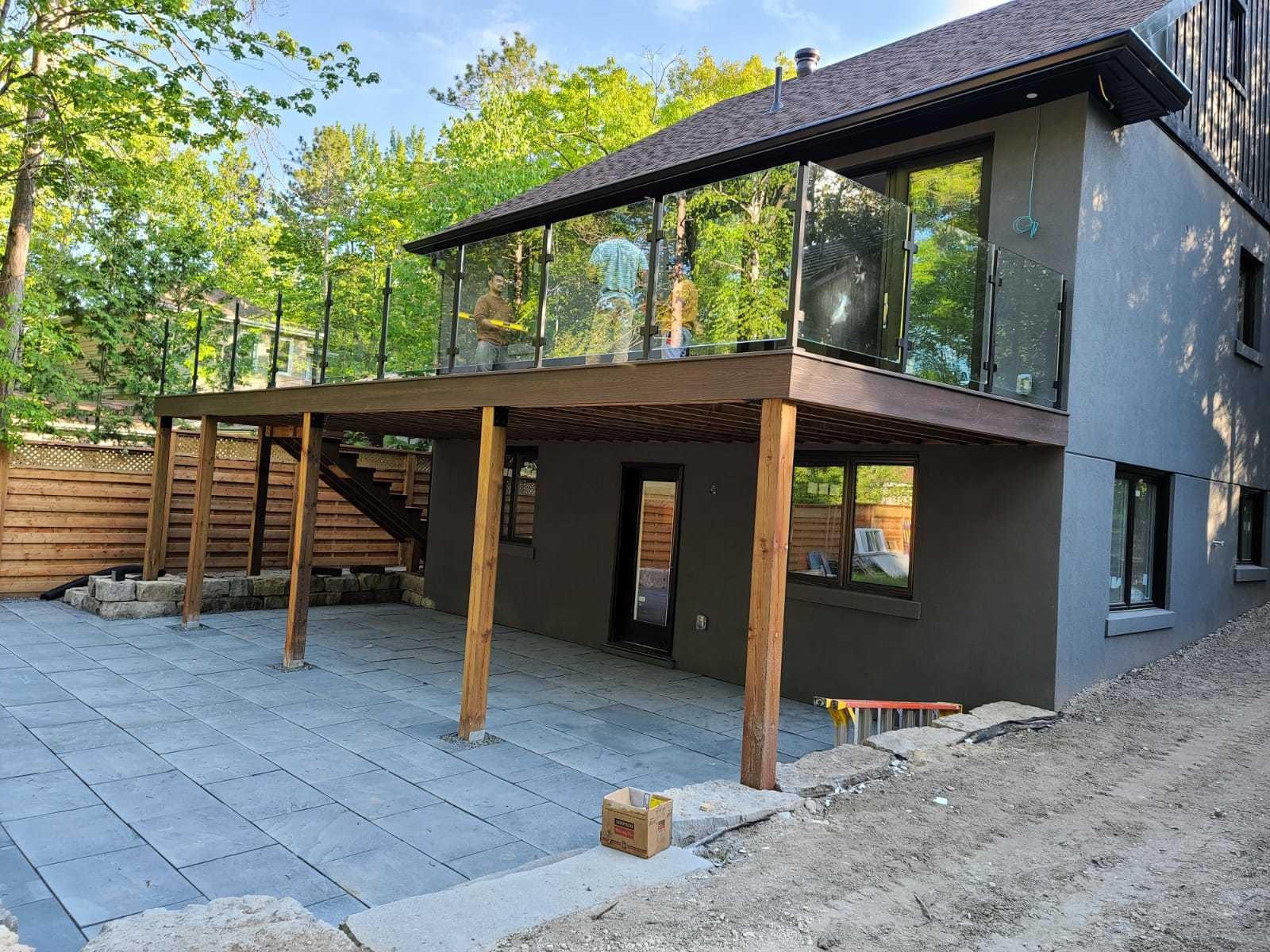
Loads have to reach structural framing: the rim (band) joist, the deck posts, or solid blocking added between joists specifically for the railing. The two common approaches are fascia-mounting (standoffs or brackets through-bolted to the rim joist) and top/surface-mounting (a base plate or base shoe fastened down into blocking below). Both depend on what's behind the connection:
- Blocking is usually required. Most existing decks don't have framing where the railing needs it, so we add solid blocking between joists or reinforce the rim before anchoring.
- Fasteners are structural, not screws. Through-bolts with washers and backing, or rated structural lag screws into solid members — never deck screws.
- Moisture is designed for. Outdoor wood means 316 stainless hardware, plus flashing and detailing so the new penetrations don't trap water and rot the framing you just bolted to.
Because the capacity of an existing wood deck isn't a given, wood substrates are the ones most likely to need framing upgrades — and an engineer's review — before a frameless glass guard is code-compliant.
Anchoring to Concrete & Masonry
Concrete is the ideal substrate for glass railings, which is why balcony slabs, poured patios, and concrete porches make for the cleanest installs. The anchorage options are high-capacity and predictable:
- Core-drilled spigots set into the slab in high-strength non-shrink grout or structural epoxy.
- Base-shoe channel bolted to the slab with expansion or epoxy anchors and then dry- or wet-glazed.
- Cast-in embeds where the railing is planned before the concrete is poured — the strongest option of all.
The main checks on concrete are slab thickness and edge distance: anchors set too close to a slab edge can break out the concrete, so the layout has to respect minimum edge distances. On balconies, the existing waterproofing membrane has to be preserved or properly re-detailed around every penetration. Done right, a concrete-anchored glass railing comfortably exceeds the code loads.
Mounting Systems Compared
The mounting system and the substrate have to be chosen together. Point-fixed spigots, for example, concentrate the entire load into a few anchors — fine in concrete, demanding on wood.
| System | On a Wood Deck | On Concrete |
|---|---|---|
| Base shoe (continuous channel) | Needs continuous solid blocking or a structural fascia; spreads load well | Excellent — bolts or epoxies straight to the slab |
| Spigots (point-fixed) | High point loads — robust blocking and through-bolts; engineer likely | Straightforward — core-drill and grout, or cast-in |
| Standoffs (face-fixed) | Into the rim joist or structural fascia, never the deck boards | Into the slab face with sleeve or epoxy anchors |
| Posts with glass infill | Through-bolted to framing; most forgiving on wood | Base plates anchored to the slab |
Point-fixed spigots on an ordinary wood deck with no added blocking. It looks minimal and modern, but it funnels the full guard load into a handful of fasteners landing in framing that was never designed for it. On wood, a base shoe or a posted system spreads the load far more safely — or the framing gets reinforced first.
When You Need an Engineer & a Permit
For the full municipal picture — the 600mm rule, OBC 9.8.8 heights and loads, and how each GTA city handles applications — see our Ontario glass railing permit guide. Exterior guards generally require a building permit under OBC Section 9.8.8, and the guard has to be shown to meet the code loads. On concrete, standard details often satisfy that. On wood — especially point-fixed systems, taller drops, or older decks of uncertain capacity — a reviewer frequently wants an engineer's stamp confirming the framing and connection.
Built By Glass supplies the product specification and OBC compliance documentation for your permit package on every railing, and we arrange stamped engineered drawings for the jobs that need them. We assess the substrate at the free measure and tell you plainly what your specific deck or balcony requires — including whether framing needs reinforcing before any glass goes up.
Common Questions
Can you install a frameless glass railing on a wood deck?
Yes, but the railing must anchor into the deck's structural framing — the rim joist, posts, or solid blocking — not just the deck boards. We use structural through-bolts or rated lag fasteners into framing capable of carrying the guard loads, and many existing wood decks need added blocking or reinforcement first.
What's the difference between mounting glass railings on wood versus concrete?
Concrete accepts high-capacity anchors (core-drilled epoxy anchors, cast-in embeds, or a bolted base shoe) and carries the load easily. Wood relies entirely on the connection to its framing, so the load path, blocking, and fastener spec matter far more — and wood is more likely to require an engineer's review for code compliance.
Do glass deck railings need a permit in Ontario?
Exterior guard railings generally require a building permit under Ontario Building Code Part 9, Section 9.8.8, with the guard engineered to resist the code-specified loads. We supply the product specification and OBC compliance documentation for the permit package; your local municipal building department issues the permit.
What glass thickness is required for an exterior railing?
We specify 12mm fully tempered glass as standard for exterior railings, and laminated tempered glass where the drop height or wind exposure warrants the additional safety margin. Outdoor hardware is 316 marine-grade stainless steel for long-term corrosion resistance.
For mounting systems and per-linear-foot pricing, see our glass railing installation page.
Planning a Glass Railing?
Built By Glass installs frameless showers, glass railings, and custom mirrors across the GTA — measured, fabricated, and installed to a single founder-led standard, backed by a five-year written warranty.
Get a Free QuotePrefer to talk it through? Call 647-778-0430.