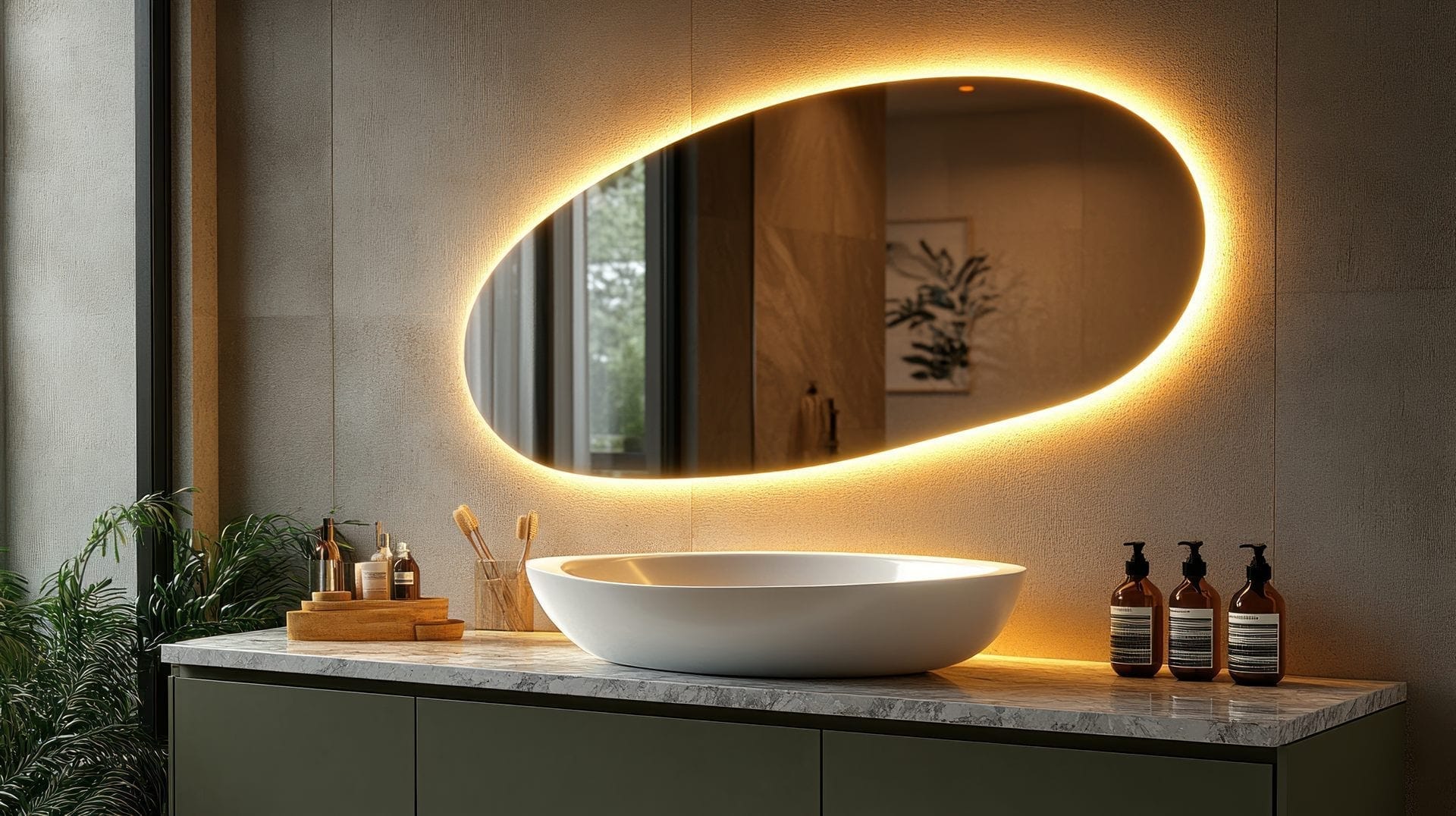
Custom mirrors are the most underrated glass upgrade in residential design — and they have the best ROI per dollar of anything in our service range. A properly proportioned, correctly installed custom mirror transforms a room visually in a way that's difficult to achieve with any other material at anywhere near the same cost. This guide covers sizing rules, placement principles, edge options, and room-by-room design guidance so you can make the right call for every space in your home.
Why Custom Beats Store-Bought — Almost Always
The standard argument for store-bought mirrors is convenience and cost. These arguments are real but often misapplied. A standard-size bathroom mirror from a home goods store fits a standard-size vanity — which is fine if your vanity is a standard size (typically 600mm, 750mm, 900mm, or 1200mm). The moment you have a custom-width vanity, an unusual wall configuration, or a double-sink vanity that runs to a non-standard length, you're either accepting an ill-fitting mirror or paying a significant premium for a store-bought "oversized" option that still doesn't fit exactly.
Custom mirrors eliminate this problem entirely. They're cut to the millimetre — the exact width of your vanity, the exact height you want — with edge profiles, drilling patterns for any mounting hardware, and silvering quality specified upfront. The result looks intentional in a way that a standard mirror on a non-standard wall never quite achieves.
On cost: for mirrors up to about 1000mm × 800mm (a typical single-vanity bathroom mirror), standard options from quality suppliers (IKEA LOTS aside) often approach the cost of a custom-cut equivalent. For anything larger — a double-vanity mirror running 1500mm or more, a floor-to-ceiling leaner, a gym wall — custom is almost always the better value. You're paying for precision, not for the luxury of custom as a concept.
Bathroom Vanity Mirrors: The Sizing Rules
Bathroom mirrors have well-established proportional rules that interior designers follow, and they exist because they work visually. Understanding them helps you spec a mirror that looks considered, not accidental.
Width: 70–80% of vanity width (or full width for a statement)
A mirror that's narrower than 70% of the vanity reads as undersized and loses visual connection with the vanity below. Full-width (edge to edge with the vanity or wall-to-wall) makes a strong, deliberate statement. The 70–80% rule is the safe middle ground that works in almost all contexts.
Bottom edge: 5–7cm above the faucet/backsplash
Hang the mirror too close to the faucet and there's a practical cleaning problem (steam, splash). Too high and the mirror disconnects from the vanity. 5–7cm above the highest point of the faucet is the standard clearance.
Top edge: roughly at ceiling or at 200–250cm from floor
Tall mirrors that approach the ceiling make bathrooms feel dramatically taller. Mirrors that stop at 180cm or lower often feel truncated. Unless there's a structural constraint, err toward taller — you can always stop at the soffit or ceiling line.
Double vanity: one large mirror vs. two individual mirrors
One large mirror across a double vanity is visually cohesive and photographically stronger. Two individual mirrors work when there's a design element between the sinks (a column, a medicine cabinet) that makes two mirrors make sense architecturally. Default to one large mirror unless there's a strong reason not to.
Full-Length Mirrors: Placement for Maximum Effect
Full-length mirrors (typically 500–600mm wide × 1700–2000mm tall) serve a practical function — getting dressed — but their impact on a room goes beyond that. A well-placed full-length mirror visually extends the room by reflecting both natural light and the space itself. The placement rules:
Mount it plumb. A full-length mirror hung perfectly vertical (at 90° to the floor) gives the truest reflection. A mirror that leans or tilts — even 2–3° off vertical — introduces a subtle lengthening or shortening distortion. This is particularly important for a mirror being used for dressing, where vertical proportions matter.
Against a wall opposite a window maximizes light reflection and makes the greatest visual impact on room brightness. In a bedroom, placing a full-length mirror on the wall across from the window reflects the natural light source and can significantly brighten a north-facing room.
Avoid placing mirrors directly opposite bedroom doors in most cases — the reflection of the door opening is visually confusing and in some design traditions considered inauspicious. The adjacent wall or the interior of a closet door are both better placements.
"A mirror doesn't just reflect — it doubles the perceived space and light in a room. In Toronto condos where every square foot matters, a custom full-length mirror is the most impactful single upgrade you can make."
Built By Glass — Design Consultation NotesFeature Wall Mirrors: The Bold Move
A mirror feature wall — typically covering most or all of one wall in a dining room, living room, or bar area — is one of the most dramatic transformations in residential design. Done well, it creates a sense of limitless depth, doubles the visual impact of art and furnishings already in the room, and reflects candlelight or pendant lighting in a way that's impossible to achieve otherwise.
Done poorly, it reads as cheap (hair salon, fitness studio) or confusing (mirrors in the wrong place, wrong size, wrong edge treatment). The key differentiators:
- Use 6mm glass minimum. Thin 4mm mirror glass shows distortion and warping when spanning large widths. 6mm stays flat over longer spans and gives a true reflection.
- Frameless edge treatment. A mirror wall that terminates with a polished or beveled edge (and perhaps a thin metal trim) looks intentional. A mirror wall that's caulked to the adjacent surfaces in a thick silicone bead looks like a quick fix.
- Consider partial coverage. A mirror panel that covers 70–80% of a wall, framed by a strip of adjacent wall on each side, often reads as more intentional than full coverage. It's a mirror as a design element rather than as a visual trick.
- Light the adjacent space, not the mirror. Mirrors amplify light. Point your pendants or track lighting at the furnishings or art you want amplified — the mirror will take care of the rest.
Ready to design your custom mirror?
Built By Glass custom-cuts mirrors to exact specifications across the GTA. Beveled edges, custom shapes, large-format feature wall panels. Free consultation.
Gym & Fitness Mirrors: The Practical Spec
Home gym mirrors have become one of the most requested custom mirror applications since 2020. The requirements are different from decorative mirrors: the priority is accurate reflection for form checking during exercise, coverage from floor to ceiling, minimal joining seams across the wall, and safety.
Safety first: gym mirrors should be 6mm glass — not 4mm — for rigidity and to reduce distortion across large spans. If there's any risk of direct impact (proximity to weights, cable attachments, or exercise equipment that could swing), consider laminated mirror glass, which holds together if broken rather than shattering. Standard tempered mirror glass is not currently widely available — standard mirrors are annealed, which is why the 6mm thickness matters for rigidity.
Panel joining: a full gym wall typically requires multiple panels. The seam between panels should be as tight as possible (typically 2–3mm) and the panels should be installed so the reflections align seamlessly. Misaligned mirror panels at a seam create a disorienting double-image effect that's particularly problematic when checking form. Precision cutting and installation matters here.
Mounting: gym mirrors are typically adhesive-mounted with mirror mastic (a mirror-safe adhesive that doesn't corrode the silvering) plus mechanical clips for safety. Clips alone aren't recommended for large panels as they create point stresses at the clip locations over time.
Beveled vs Flat Edges: When Each Is Right
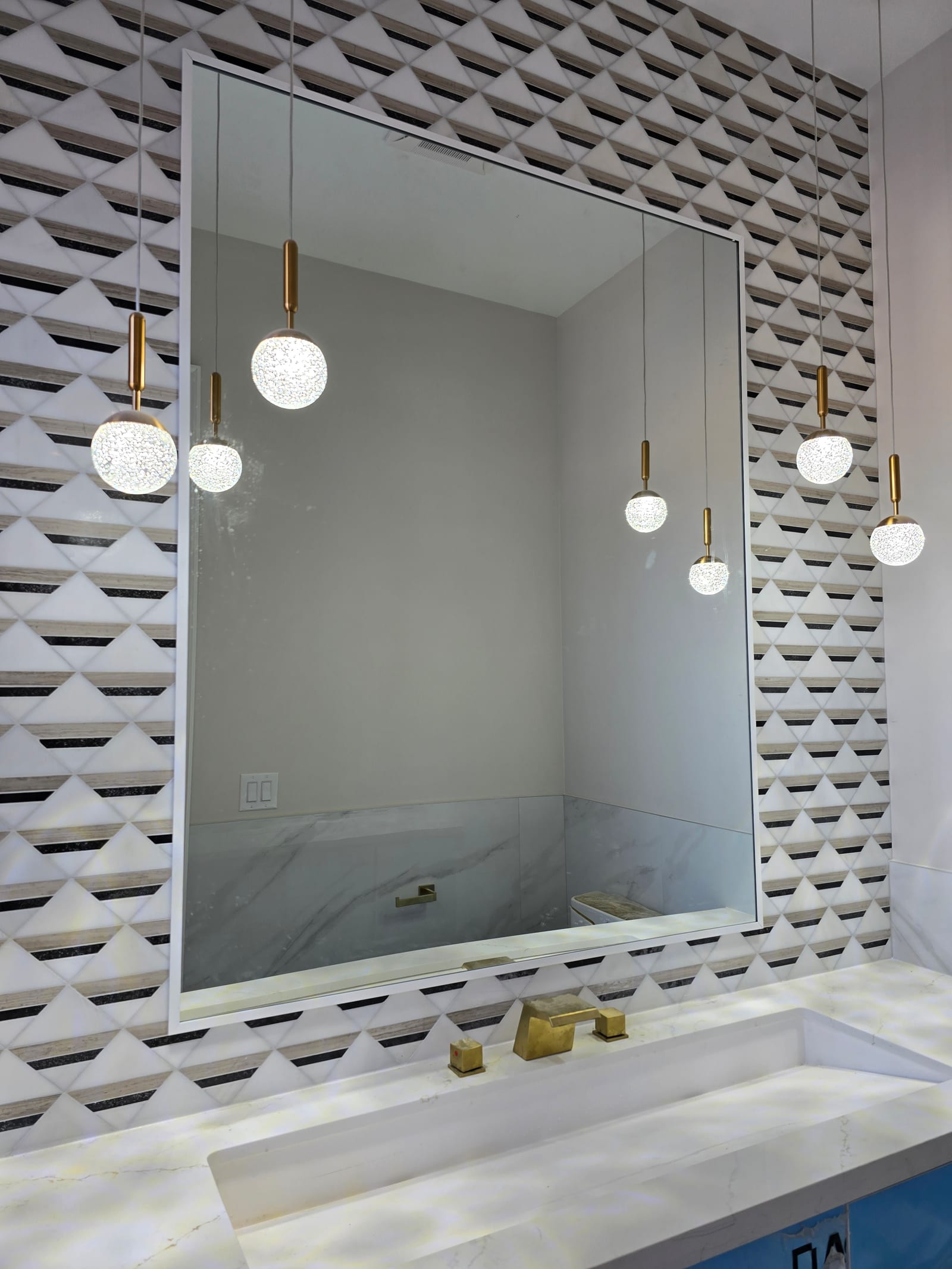
The edge profile of a custom mirror is more visible than people expect — particularly on frameless mirrors where the edge is exposed at eye level. The two main options:
| Edge Type | Appearance | Best For | Cost Premium |
|---|---|---|---|
| Flat polished | Clean, minimal, invisible edge | Contemporary and minimalist bathrooms, gym mirrors, large feature walls | None — standard finish |
| Beveled (25–38mm bevel) | Angled facet around perimeter that catches light and creates a frame effect | Traditional and transitional bathrooms, dining room mirrors, anywhere a "framed" look is wanted without actual frame | +15–25% |
| Pencil edge | Small rounded edge — subtler than bevel | Secondary bathrooms, smaller mirrors where beveled feels too heavy | +10–15% |
| Decorative cut shapes | Arched tops, geometric shapes, custom profiles | Feature mirrors, powder rooms, entry statements | +30–60% |
For a contemporary master bath, flat polished edges are almost always the right call. The clean edge reads as sophisticated and doesn't compete with the hardware or tile. For a powder room where you want the mirror to be a visual statement, an arched top or beveled edge adds character. For gym mirrors, flat polished — anything else creates visual distortion at the edge during exercise.
Glass Thickness and Distortion
Mirror glass thickness is a more important specification than most homeowners realise, particularly for larger panels. Many store-bought bathroom mirrors use 4mm glass, which is fine for panels under about 800mm in width. At wider spans, 4mm glass flexes slightly under its own weight when wall-mounted, creating subtle distortion that makes reflections look slightly wavy — like a funhouse mirror at very low intensity.
For any mirror wider than 800mm or taller than 1000mm, 6mm glass is the correct specification. The additional rigidity eliminates the flex distortion and produces a truly accurate, flat reflection. The weight increase is manageable, and the mounting hardware selection is the same — simply ensure the wall mastic and clips are rated for the extra weight.
For very large installations (gym walls, feature dining walls, mirrors spanning full bathroom widths of 1800mm+), 6mm is mandatory. At these spans, 4mm glass will almost certainly show distortion and may be prone to edge stress fractures at the mounting points over time.
What Custom Mirror Installation Actually Involves
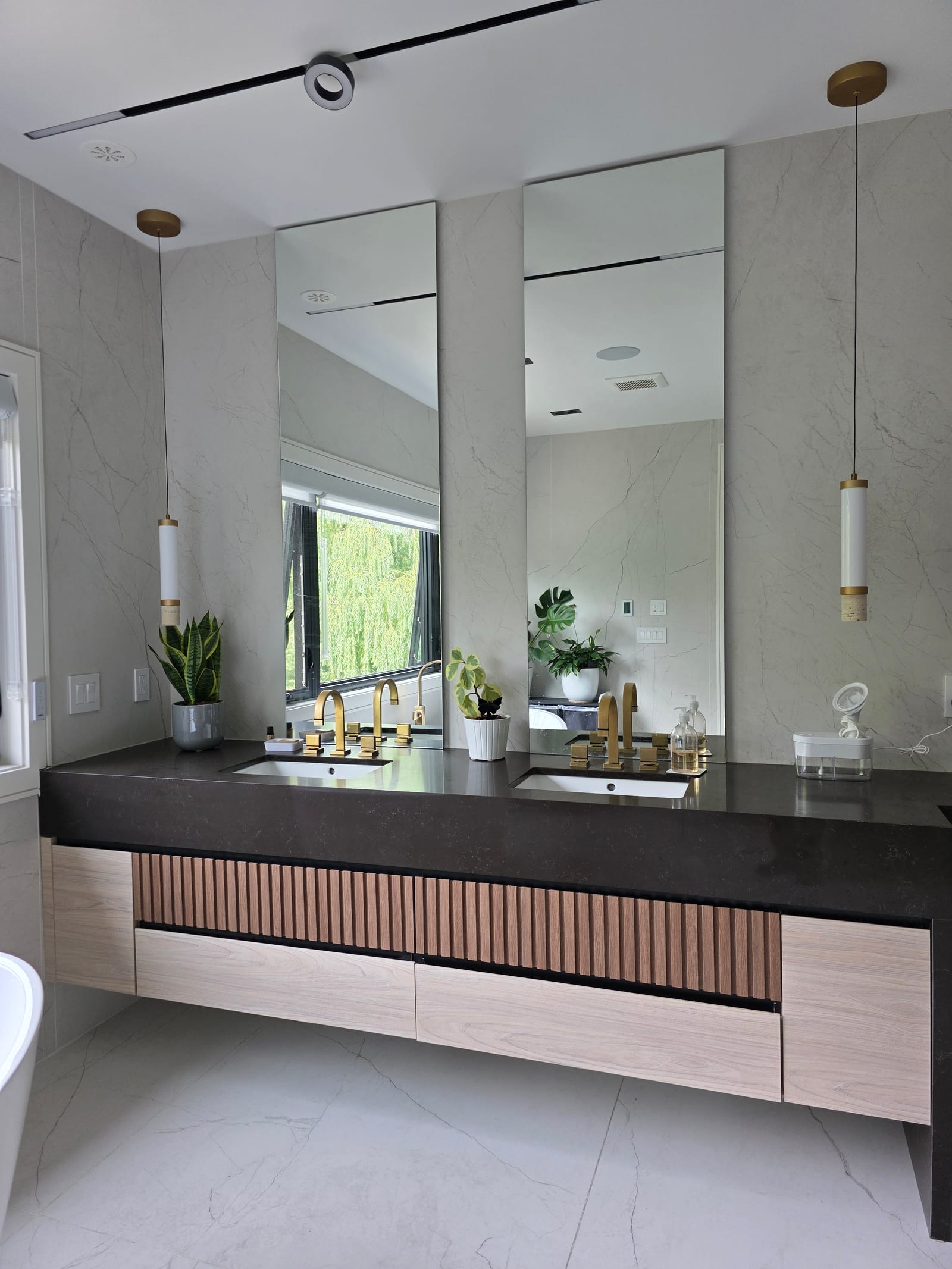
Custom mirror installation is not a straightforward DIY project, primarily because of the silvering risk we described in our care guide — any moisture or cleaning solution that reaches the back of the mirror during or after installation begins to corrode the silver coating immediately. Professional installation ensures the correct adhesive (mirror mastic, not general construction adhesive which off-gasses and corrodes silvering), correct mechanical support, and a moisture management strategy for bathroom installations.
Professional installers also handle the weight and handling of large glass panels safely — a 1500mm × 900mm mirror at 6mm weighs approximately 20 kg, and the handling risk of cracking a corner or edge during positioning is real without the right technique and equipment.
- Glass thickness (we install 6mm silvered glass as standard)
- Edge profile (flat polished, beveled, pencil, or custom shape)
- Exact dimensions to the millimetre
- Any cutouts (for light fixtures, outlets, or custom shapes)
- Mounting method preference (concealed clips, face clips, or adhesive only)
- Room humidity (bathroom, gym, or dry living space — affects adhesive choice)
Frequently Asked Questions
Custom mirrors from Built By Glass start at $25 per square foot installed, with no project minimum. Final pricing depends on size, edge profile, and any cut-outs needed for outlets or sconces. A written quote follows a free in-home measure.
The working rule: size the mirror to roughly 70–80% of the vanity width (or run it full width for a statement), and tall enough that everyone in the household sees their full head and shoulders — typically 36 to 40 inches of height. Wall-to-wall panels that run the full vanity width are the current high-end standard and make small bathrooms read larger.
Flat polished edges suit contemporary spaces and are the standard on frameless vanity and gym mirrors. A beveled edge adds a traditional, furniture-like border that works in classic and transitional interiors. Neither affects durability — it's an aesthetic choice, though bevelled work typically prices slightly higher.
Yes — gym and studio mirror walls are one of our most common custom mirror projects, from single-panel home gyms to full commercial studio walls. Panels install edge-to-edge with polished seams for a continuous wall, priced from $25 per square foot with no project minimum.
Design your custom mirror with Built By Glass
From bathroom vanity mirrors to gym walls and feature dining mirrors, Built By Glass fabricates and installs custom mirrors across the GTA with precision cutting, correct glass thickness, and expert mounting. Free consultation.
Prefer to talk it through? Call 647-778-0430.